
ENGINEERING
Inside the decisions behind GreenBeam.
Every design choice in GreenBeam traces back to a specific engineering constraint. This section documents the reasoning in plain English: why we chose edge AI over cloud processing, RTK and LiDAR over simpler navigation, all-wheel drive over a fixed drivetrain, and virtual boundaries over buried wire. It exists so engineers, journalists, and informed homeowners can evaluate GreenBeam on the merits of its design, not marketing claims.
ARTICLE
Why edge AI?
GreenBeam identifies individual weeds in real time while moving across a lawn, in variable outdoor lighting, with no guaranteed network connection. Sending every camera frame to the cloud for analysis and waiting on a response is too slow for a robot deciding, moment to moment, whether the plant in front of it is a weed or turf grass.
That is why classification runs onboard, on an NVIDIA Jetson Orin Nano. The Orin Nano is purpose-built for running trained vision models directly on the device, so GreenBeam makes detection and treatment decisions locally, in the time it takes to pass over a patch of lawn. There is no round trip to a server, no dependency on home Wi-Fi coverage across the yard, and no interruption if connectivity drops.
Onboard processing also means the vision model runs consistently regardless of network conditions at the edge of a property, which is exactly where lawns tend to have the weakest signal.
ARTICLE
Why RTK + LiDAR?
Operating outdoors and unattended requires two distinct kinds of spatial awareness, and neither one alone is sufficient. RTK, real-time kinematic positioning, gives GreenBeam centimeter-level knowledge of where it is on the property relative to the boundaries it has been taught. LiDAR gives it moment-to-moment awareness of what is physically around it right now: a garden bed, a low branch, a pet, a person.
RTK answers "where am I on this lawn." LiDAR answers "what is in front of me right now." A robot with only one of these can know its location precisely but still collide with an obstacle that was not there yesterday, or it can react to nearby objects but drift outside the area it is meant to treat. GreenBeam uses both together so precise positioning and immediate spatial awareness reinforce each other throughout every patrol.
ARTICLE
Why all-wheel drive and in-wheel motors?
Residential lawns are rarely flat. Slopes, drainage swales, root heaves, and uneven turf are the norm, not the exception. A drivetrain built for a warehouse floor will slip, stall, or lose traction the moment it meets a real yard.
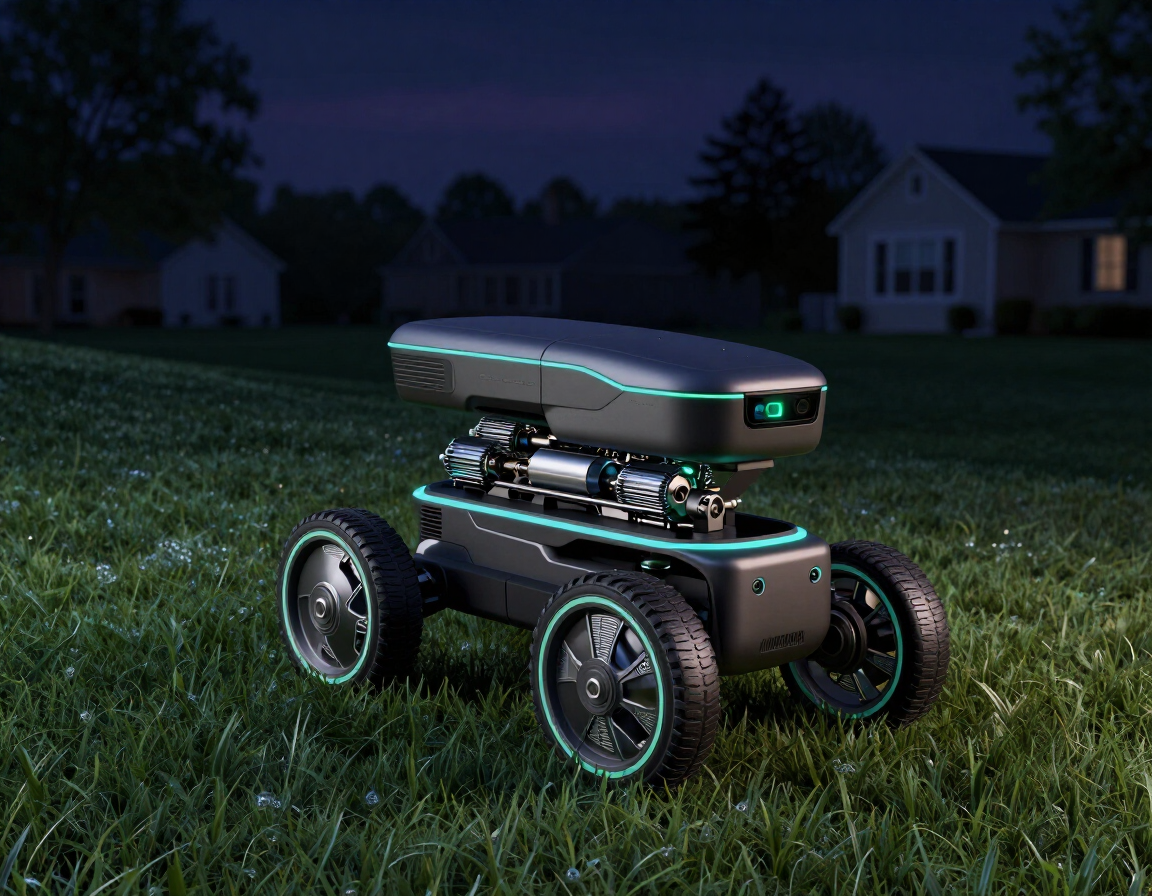
GreenBeam uses all-wheel drive with in-wheel motors, so each wheel is driven independently and can respond to the terrain under it rather than depending on a shared drive shaft or differential. This distributes torque to whichever wheels have traction, keeps the chassis stable on uneven ground, and lets the robot hold a controlled line across a slope instead of sliding sideways.
Slope-capability specifications are being finalized ahead of publication. To be published.
ARTICLE
Why virtual boundaries instead of buried wire?
Traditional robotic garden equipment defines its work area with a physical wire buried around the perimeter. That wire has to be installed, trenched into the lawn, and repaired whenever it is nicked by a spade or a stray weed treatment. It is also fixed: adjusting the boundary means digging it up and moving it.
GreenBeam replaces the wire with a virtual boundary built from the same RTK positioning it uses to navigate. The perimeter is defined once, in the GreenBeam App, by walking or marking the edge of the lawn, and stored as a set of precise coordinates. GreenBeam then holds itself inside that boundary using centimeter-level positioning, with no cable in the ground.
The advantage is flexibility: the boundary can be redrawn in the app the moment the lawn changes, whether that is a new garden bed or a section under renovation, without a shovel involved.
ARTICLE
How plant recognition works
Plant recognition happens in a continuous pipeline as GreenBeam moves across the lawn. First, onboard cameras capture live video of the ground ahead. Second, the Jetson Orin Nano runs that video through a trained computer vision model, frame by frame, looking for the visual signatures of known weed species.
Third, the model classifies each detected plant, distinguishing target weeds from turf grass and desirable plants. Fourth, GreenBeam makes a decision: treat, or move on. This is the moment a Photon Cyan bounding overlay appears around a detected plant, signaling that the system is actively sensing and evaluating it, before the decision is finalized.
ARTICLE
How precision targeting works
Confirming that a plant is a weed is only half the task. GreenBeam then has to aim precisely, and it does so at the growth point, the meristem, rather than treating the whole plant indiscriminately. The meristem is where new growth originates, which makes it the most effective point of treatment.
This is where GreenBeam's signature visual sequence plays out. A Photon Cyan bounding overlay marks the plant as it is being evaluated, signaling active sensing. Once the system locates the meristem and confirms the target, the overlay contracts into a Beam Green circular lock labeled TARGET CONFIRMED. That color change, cyan to green, is the visual language GreenBeam uses everywhere to mean "the machine is sensing" versus "the machine has acted."
Only after target confirmation does GreenBeam apply precision light treatment to that single point, leaving the surrounding turf untouched. Treat the weed. Not the lawn.
ARTICLE
How GreenBeam returns home
When a patrol is complete, or when GreenBeam determines it should head back, it uses the same RTK positioning that guides it around the lawn to plot a precise route back to the GreenBeam Garage. Because its location is known to centimeter-level accuracy throughout the property, it can navigate directly to the garage's entrance rather than searching for it.
On approach, GreenBeam aligns with the garage's docking mechanism and completes the connection automatically, without a person needing to guide it in. From there, it charges and waits for its next scheduled patrol. Mission progress and dock status are visible in the GreenBeam App throughout.
See the engineering in action.
Read the full technical breakdown, or back the campaign that is bringing GreenBeam to lawns now.